
Much has been debated about the problem and potential of monuments. Perhaps this is because monuments sit at a pivotal crossroad in the landscape of cultural memory. They have been as much painful reminders of violent, unresolved pasts as they have been a medium full of possibilities to imagine new futures. While recent public discourse on monuments has generally been preoccupied with whether racist monuments should be toppled or what should replace them, one framework answers and goes beyond both questions by centering communities in an unprecedented way.
Redress, when applied to monuments, privileges historically harmed communities’ experience, expertise, and needs. It reminds us that the work of monuments can be much more than melting down bronze or erecting new structures. More specifically, redress reframes the purpose of monuments, allowing them to be a path toward materializing what communities want most. Without this focus, work to dismantle or create new monuments can fall into a rut, rehashing the question of what we do with monuments rather than prioritizing the local perspectives of people whose histories have been painfully silenced and who have endured the legacies of harm that the monuments represent.
Whether in major cities, rural towns, tribal communities, or US territories, the Re:Generation project shows how redress can enable care and attention to extend beyond the physical monument to include impacted communities. This intervention not only shifts historical narratives, but also reverberates far beyond the commemorative landscape to catalyze broader social transformation. The work marks a regeneration of history that more accurately tends to those living its afterlives. Put simply, it turns to them to dictate the future of monuments.
The “Problem” of Monuments
Public attention to monuments often crystalizes during crucial moments of reckoning, whether inspired by a regime change or a social movement. Monuments—toppled, defaced, protected, or preserved—have long served as symbolic battlegrounds to contest how and what we remember about our collective past. Ongoing efforts to confront the legacies of colonialism and white supremacy have been punctuated by movements to remove monuments that celebrate past harms and serve as potent reminders of racism’s endurance in the present. Faced with the problem of these monuments, museums and heritage institutions are often called upon to determine whether they should be taken down, and if so, what happens next? But all too often, these conversations foreground whiteness and the political reputations of institutions and state actors at the expense of local communities most harmed by the monumental celebration of racism 1
Through the lens of redress, the role of museums and other cultural institutions can shift.2 Rather than self-identifying as the purveyor of solutions, institutions have an opportunity to begin with honest reflection about their participation and complicity in perpetuating harm. One example piloted by museum professionals at the Smithsonian’s Center for Restorative History offers a theory and methodology to advance this work. In consultation with Monument Lab and community partners around the country, center staff developed an approach to memory work called restorative history, which uses the power of reframing the past as a tool to address the harms of exclusion from our national story in transformative ways. As an outgrowth of restorative justice principles, restorative history seeks to bring harmed communities and perpetrating institutions together in a four-step process to: 1) address historical harms, 2) identify a community’s present needs, 3) fulfill stated institutional obligations, and 4) explore root causes of injustice through the study of history. In doing so, restorative history exposes silenced truths, redefines the notion of belonging, changes our institutions to cede authority to communities, and moves us toward justice.3
This approach, like other redressive frameworks, proposes new questions about monuments that represent and perpetuate harm. Redress work privileges the experiences and needs of communities most affected, asking: what does the community want and need by way of this monument? How can their desires be centered in the act of removal or preservation and the subsequent steps to right past wrongs? This approach presumes that there is no one-size-fits-all answer for how to grapple with monuments. Rather, redress engages historically harmed communities as the experts of their own history and local needs. Institutional obligations, then, are to listen to and collaborate with community stakeholders to define the best path forward. Importantly, partnerships built on restorative history focus on opportunities for mutual capacity building and resource sharing to meet the diverse needs of the community. In some cases, this may mean supporting efforts to preserve a vandalized monument and reinterpret its meaning in the contemporary landscape. For other communities, support may include monument removal followed by a project to narrate previously untold local histories or address systemic inequalities more directly.
The Potential of Monuments
For as much as monuments have generated pain and controversy, the medium itself is still well regarded for its potential to support healing. Commemorative monuments continue to be the primary currency for national and international efforts to mark historic events, and they are commonly produced as a form of symbolic reparation for past atrocities.4 Projects like those supported under Monument Lab’s Re:Generation similarly believe in monuments' power and potential. At stake is not only what or how we remember; monuments influence what is visible, knowable, and valuable in our communities, in turn dictating how we distribute resources, seek justice, and define belonging. If monuments are to serve us in the construction of alternative futures, the tools and process by which they are created also must be reimagined.
Many of the projects represented by Re:Generation are living examples of redress work in action. Above all, they productively use monuments as an entry point to address the present-day ramifications of historical harm. Courage in the Hollers uses community-based participatory research and design to map labor histories of multiracial, unionist coal miners in Appalachia. It is only the first phase of a larger project that will work with descendant communities to create interpretive spaces on a 50-mile stretch where miners collectively marched for their rights over a century ago. The goal of the project ultimately does more than mark the landscape; it cements in public memory an intentionally silenced history of racial solidarity against corporate power that still resonates today. Similarly, The More Up Campus uses monuments as an entry point to confront the gruesome history of medical experimentation on enslaved Black women in Montgomery, Alabama, that created the field of gynecology. A community health clinic and museum will follow to meet the wellness needs of the city’s Black women and mothers who contend with racial disparities in health care that too often have deadly consequences. The Rapid City Indian Boarding School Lands Project powerfully searches for the graves of Lakota children who lived and died at the school, leveraging education, research, and outreach to create a project that is as much about memorialization as it is about land, sovereignty, and grappling with generational trauma. Moreover, Walking with Dinétah engages the ancestral Diné landscape as a living monument imbued with ancestral knowledge. Through oral histories, art, and place-based storytelling, the team encourages literal and figurative walking along Diné trails, challenging publics to create a relationship of shared resilience and healing with the environment through the lens of an Indigenous worldview.
As the Re:Generation projects lay bare, monuments are not static historical objects; they echo across generations with the power to inspire as much as instill fear. Redressive frameworks highlight that monuments are part of a web of relationships in the past and the present. The process of redress invites perpetrating actors and institutions to the table to be held accountable and right wrongs. It also opens up the monument debate, reckoning with the past while firmly grounded in the practical needs of harmed communities in the present.
Today public officials faced with a controversial commemorative landscape are often searching for clear answers about the appropriate way to deal with monuments and our nation’s history. The desire for a yes or no answer on taking down monuments or remaking them presumes that the work stops there. When we acknowledge that monuments traffic in moral ideologies, they cannot be examined on the grounds of historic preservation alone. Seen in this way, neither removing a racist monument nor erecting a new monument can be the end of the work.
Monuments still spark imagination and promise for a new generation of memory makers. Just as innovative projects continue to emerge, debates persist over how to deal with our national inheritance of problematic monuments. At this nexus of monuments as potential and problem, redress calls for a focus on the localized needs of historically harmed communities. Re:Generation opens new possibilities for this work by supporting the vision of community-based projects to transform monuments from symbols of oppression into catalysts for justice.
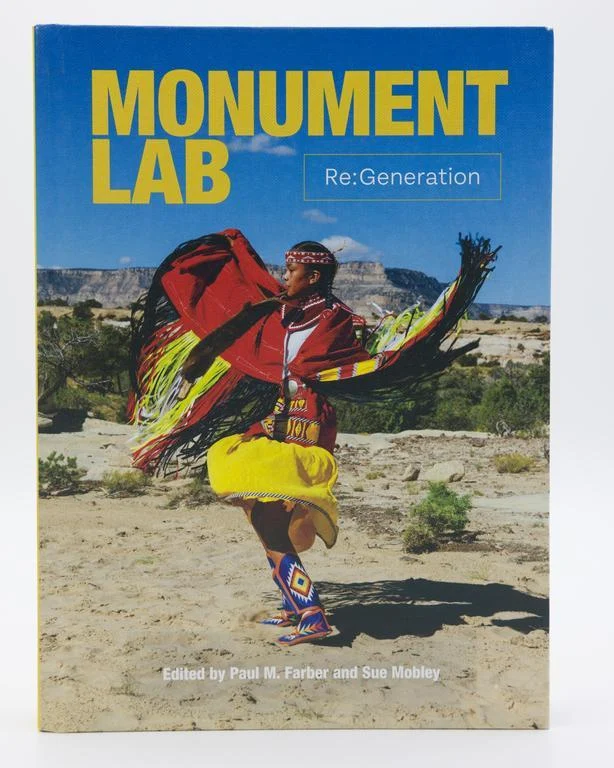
About Monument Lab: Re:Generation
Monument Lab: Re:Generation presents case studies that travel across America, highlighting local commemorative campaigns dedicated to advancing public memory. Featuring articles and artwork from the country’s leading monument makers, each project includes a framing essay that provides insights into the varied contexts of location, culture, form, and subject matter.
Edited by Paul M. Farber and Sue Mobley